Diglot vs Copyleaks
The Copyleaks alternative for people who think in another language first: draft, translate, rewrite and check grammar in one editor.
- Your work was flagged and you need concrete evidence for the review meeting, not a counter-score
- You write English as a second language and know detectors flag writing like yours more often
- You want a defense that exists before any accusation — an authorship record built from the first draft
- You write across two languages and want translation, grammar, and drafting in one editor while the process record builds itself
No credit card required · Your text opens in the editor after sign-up
When Diglot is the better pick over Copyleaks
Diglot does not compete with Copyleaks at detection — it answers what a detector cannot: who actually wrote this? Detectors judge output; Diglot shows your work.
One window instead of five tabs and five bills
Before: five tabs
- Jenni AIAutocomplete and citations, but no help with a second language.~$20Unlimited, monthly
- DeepL ProTranslates outside your document, so citations and tone are lost.~$8.74from, monthly
- QuillBot PremiumRewrites one paragraph at a time in a separate tab.$19.95monthly
- Grammarly ProFixes the sentence without naming the first-language habit behind it.~$12per month, billed yearly
- ChatGPT PlusRewrites in its own voice and can invent references.$20monthly
If you pay for all five~$81/ month
After: one Diglot document
- Drafting, autocomplete and citations
- Translation inside the document
- Rewrites in five tones
- Grammar that names your first-language habits
- Cowriter with 30+ skills, every edit waiting for you
- Your PDFs, your glossary and a free Authorship Certificate
Publicly listed prices: Jenni AI verified 2026-07-18; DeepL, QuillBot and Grammarly verified 2026-04-13; ChatGPT Plus as listed by OpenAI. Prices change, so check each vendor before you buy.
Try a skill on a real paragraph
Your draft
Many researches shows that students which use social media more than three hours per day have lower grades. In our opinion this is because the constant notifications make difficult to concentrate, so the information is not stay in the memory.
We propose to migrate our reporting to the new platform in Q1. This will reduce costs a lot and the team will be more productive, because the old system is very slow and nobody likes it.
We are very sorry for the delay, it was not our fault but the supplier one. We will try to send you the goods until Friday, please be patient with us and don’t cancel the order.
Cowriter /formalize · Fluent AI
Many studies show that students who use social media for more than three hours per day have lower grades. We believe this is because constant notifications make it difficult to concentrate, so information does not stay in memory.
Example output written for this page to show the difference between AI tiers; real results depend on your text. Fluent AI is on Free, Native AI on Pro.
Every citation leads back to a real page and a real DOI
Your paragraph
The Transformer replaced recurrence with attention alone , and pre-trained encoders such as BERT carried the idea to language understanding . Attention mechanisms first improved neural machine translation .
References
- Vaswani, A., Shazeer, N., Parmar, N., Uszkoreit, J., Jones, L., Gomez, A. N., Kaiser, Ł., & Polosukhin, I. (2017). Attention is all you need. arXiv. https://doi.org/10.48550/arXiv.1706.03762
- Devlin, J., Chang, M.-W., Lee, K., & Toutanova, K. (2019). BERT: Pre-training of deep bidirectional transformers for language understanding. Proceedings of NAACL-HLT. https://doi.org/10.18653/v1/N19-1423
Your library · p. 1, abstract
We propose a new simple network architecture, the Transformer, based solely on attention mechanisms, dispensing with recurrence and convolutions entirely.
DOI resolves · 10.48550/arXiv.1706.03762
Example built from real papers and DOIs. In the editor, /library answers from the PDFs you upload, /check-sources looks each DOI up, and /find-source suggests papers for an uncited claim.
The slips your first language puts in your English
Thank you for your comprehensionThank you for your understanding
“Comprensión” is a false friend: in English it is “understanding”.
Actually, we use the old systemCurrently, we use the old system
“Actualmente” means “currently”, not “actually”.
I assisted to the conferenceI attended the conference
“Asistir a” means to attend; “assist” means to help.
temperature of samplethe temperature of the sample
Your language has no articles; English needs “the” here.
We discussed about the resultsWe discussed the results
“Обсуждать” takes a preposition; “discuss” does not.
It depends of many factorsIt depends on many factors
A calque of “зависит от”: English uses “depend on”.
Joined Sony 2020I joined Sony in 2020
Your language drops the subject; English needs it.
Yesterday I go to the clientYesterday I went to the client
The verb does not change for tense in Mandarin; English marks the past.
Sorry to bother you, if possible maybe could you send itCould you send it?
Layered politeness reads as unsure in English business writing.
He is having two carsHe has two cars
“Have” for ownership does not take the -ing form.
I am agree with the planI agree with the plan
“Agree” is already a verb; it needs no “am”.
Please do the needfulPlease take care of it
Common in Indian English, unclear to readers elsewhere.
I work here since three yearsI have worked here for three years
“Seit / depuis” becomes “for” with the present perfect.
We have discussed it yesterdayWe discussed it yesterday
A finished time like “yesterday” takes the past simple.
We will eventually postpone the launchWe may postpone the launch
“Eventuell / éventuellement” means “possibly”, not “in the end”.
Typical slips for each language group. Diglot flags them in your own draft and explains the habit behind each one.
A signed record of how the document was written
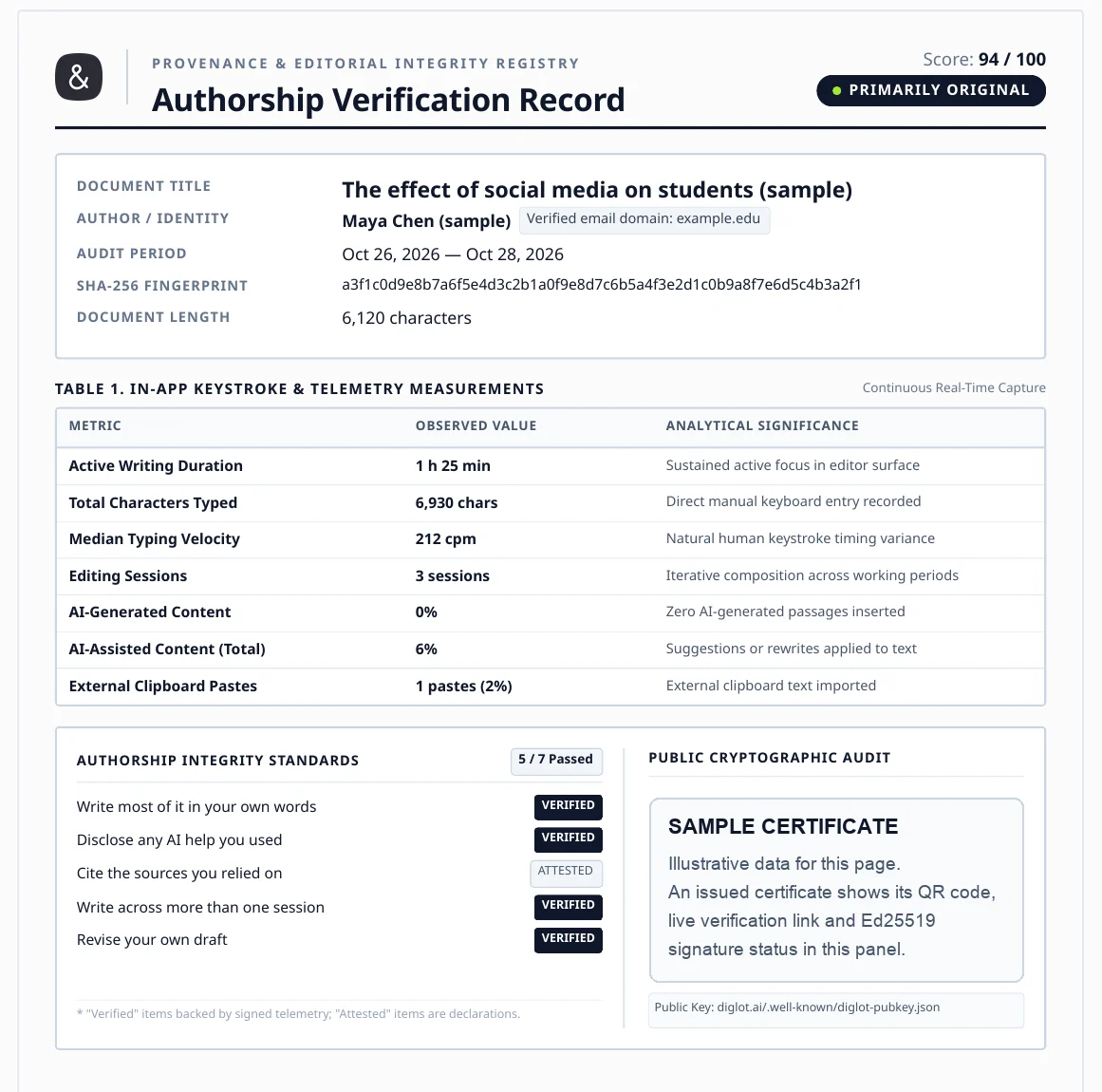
The certificate PDF Diglot issues, filled with sample data. A real one carries a QR code and a live verification link.
- Session 1 · Outline and notes22 min
- Session 2 · Drafting, two languages, 4 citations48 min
- Session 3 · Cowriter /formalize and grammar review15 min
- Certificate exported with a verification linkfree
- Example timeline. Writing the whole document in Diglot is what gives the record its weight: a pasted paragraph shows up as a paste.
Feature-by-feature comparison
| Feature | Copyleaks | Diglot |
|---|---|---|
| What it analyzes | Finished text — statistical patterns in the output | The writing process — edits, revisions, and timing as you work |
| What you get | A probability score of how likely the text is AI-generated | A signed, verifiable Authorship Certificate |
| Help when you are falsely flagged Copyleaks scores text; disputing a flag happens in the institution's own process, outside the tool. | ✗ | Process evidence you can present in an academic-integrity review |
| ESL writer awareness Detector bias against non-native writing is a category-wide problem, not something unique to Copyleaks. | Scores text in many languages; no writing support for non-native writers | Built for ESL writers — bilingual editor with native-language support in the workflow |
| Plagiarism checking | Yes — a core product with deep source matching | ✗ |
| Who it is built for | Institutions, enterprises, and educators doing the checking | Individual writers who get checked |
| Evidence before you are asked You can pre-scan your text with Copyleaks, but a clean score today does not stop a different detector flagging the same text tomorrow. | ✗ | Opt-in authorship record that exists from the first draft, before anyone questions it |
| Price for an individual writer | Credit/volume-based individual plans; institutional licensing for schools | Free plan; Spark $19/mo; Pro $34/mo (Authorship Certificate on every plan) |
Pricing
One connected writing workspace instead of paying for 4 separate subscriptions.
QuillBot ($19.95) + DeepL ($8.74) + Grammarly ($12) + Jenni ($20) = $60.69 – $81 / mo
From $15.83 / mo Save 76% ($62/mo)
Copyleaks
Single-purpose utilityInstitutional and enterprise licensing; individual plans available on a credit/volume basis
- What it analyzes Finished text — statistical patterns in the output
- What you get A probability score of how likely the text is AI-generated
- Help when you are falsely flagged — not included
- ESL writer awareness Scores text in many languages; no writing support for non-native writers
- Plagiarism checking Yes — a core product with deep source matching
- Who it is built for Institutions, enterprises, and educators doing the checking
Diglot
Complete Writing Workspace- Free$0 no card needed
- 500 words / day paraphrase
- 3,000 words / mo translation
- 10 Cowriter messages / day
- 1 Deep Research report / mo
- Authorship Certificate included
- Save 76% · Most PopularSpark$15.83 / mo, billed $190/yr $19 / month
- 30,000 words paraphrase & rewrite / mo
- 50,000 words translation · Smart AI
- 1,000 Cowriter msgs (35 skills)
- 5 Deep Research reports / mo
- 10,852 citation styles & PDF upload
- Native AI TierPro$28.33 / mo, billed $340/yr $34 / month
- Native-tier AI (publication quality)
- 50,000 words paraphrase / mo
- 100,000 words translation / mo
- 2,000 Cowriter msgs · cross-session recall
- 30 Deep Research reports / mo
Flexible on-demand word packs — no forced tier upgrades
Working on a thesis deadline or heavy paper submission? Add extra volume on demand without changing subscription tiers: +40,000 word packs ($15) and Deep Research packs are available anytime directly inside your workspace.
Pricing verified 2026-07-10. Public pricing changes — confirm on each vendor's site before purchase.
Where Copyleaks ends and Diglot begins
They score your text. We document how you wrote it.
Copyleaks is one of the serious vendors in AI content detection. Institutions and businesses use it to screen text for AI generation and plagiarism at scale, and it does that job about as well as the category allows. This page is not going to tell you Copyleaks is bad software. It is going to tell you something more useful: a detector and Diglot solve different problems, and if you are the person being scored — a student, a researcher, a writer whose work just got flagged — the difference matters. Every AI detector, Copyleaks included, works from the finished text. It looks at statistical patterns in the words and estimates how machine-like they are. That estimate can be wrong, and across the category it goes wrong more often for people who write English as a second language: a Stanford study (Liang et al., published in Patterns, 2023) found AI detectors falsely flagged 61% of TOEFL essays by non-native English speakers. That study tested the detector category, not Copyleaks specifically — but every tool in the category rests on the same kind of statistical inference. I write English as a second language myself, which is part of why Diglot exists. Diglot approaches the problem from the other side. Instead of judging the output, it documents the process. As you write, Diglot can record a signed, append-only chain of authorship events — your edits, revisions, and timing — and package it as an Authorship Certificate. When a detector score is questioned, you do not argue with a probability; you show how the work was made.
What Copyleaks sells
- AI content detection — probability scores on whether text is machine-generated
- Plagiarism detection with source matching across web sources and internal databases
- LMS integrations for institutions (Canvas, Moodle, and others)
- Enterprise API for high-volume screening
- Source-code plagiarism detection (Codeleaks)
- Detection coverage across multiple languages
Why Copyleaks wins
- Established trust with institutions — it is one of the detectors schools actually deploy, alongside Turnitin
- Plagiarism and AI detection in one suite, so an institution buys one workflow instead of two
- API-first design built for volume, which matters when you screen thousands of submissions
- Detection across many languages, not just English
- Individuals can access it too — you can scan your own text before submitting, which some enterprise detectors do not allow
Copyleaks wins when
- You are an institution or business that must screen large volumes of submissions for plagiarism and AI content
- You need LMS integration and an instructor-facing workflow, not a tool for individual writers
- You want one vendor covering plagiarism, AI detection, and source-code checking
- You are a publisher or platform screening third-party submissions before publication
Frequently asked questions
Can Copyleaks falsely flag human writing as AI?
Yes — every AI detector can, because all of them infer from statistical patterns in finished text rather than observing who wrote it. Copyleaks is a serious vendor, but no detector in this category can eliminate false positives. If your genuinely human work was flagged, the problem is the method's limits, not necessarily your writing.
How do I prove I wrote my essay myself if Copyleaks flagged it?
You need process evidence, not another score. Early drafts, version history, notes, and — strongest of all — a record of how the text came together over time. Diglot's Authorship Certificate is exactly that: a signed, append-only record of your edits and revisions that you can bring to an academic-integrity meeting.
Why do AI detectors flag non-native English writers more often?
Writers working in a second language tend to use more predictable vocabulary and sentence patterns — the same statistical signals detectors associate with AI text. A Stanford study (Liang et al., published in Patterns, 2023) found AI detectors falsely flagged 61% of TOEFL essays by non-native English speakers. This is a category-wide problem, not specific to Copyleaks.
Is Diglot an AI detector like Copyleaks?
No. Diglot is a writing platform for ESL writers — translation, grammar, and drafting in one editor — that can also record your writing process as verifiable authorship evidence. It does not score text and cannot tell you whether someone else's writing is AI-generated. The two tools sit on opposite sides of the same problem.
Should I rewrite my essay until it passes Copyleaks?
I would not. Chasing a detector score is a moving target — a different tool, or the same tool next month, can flag the rewrite again, and repeated "humanizing" edits can make your writing worse while looking like evasion. A record of your actual writing process is a defense that does not expire.
Sound like you? Try Diglot free.
If «your work was flagged and you need concrete evidence for the review meeting, not a counter-score» describes your work, the free tier covers daily writing — no card.
No credit card required
Where to go next
Copyleaks is one tool against Diglot. The picks below frame the decision against similar tools, your real workflow, and the broader category.
