Part of the flagged-as-AI hub · Updated August 23, 2026
Does Turnitin detect AI?
Yes — Turnitin returns an AI-writing score. It does not catch anyone or produce evidence, and on non-native English the estimate is often wrong.
*No credit card required
- An honest answer, not detector-evasion tricks
- What the AI score actually measures — and what it cannot
- Process evidence that holds up when a score does not
Two different numbers
What does the AI score actually measure?
Turnitin runs two separate checks. Conflating them causes more panic than either deserves. The similarity score measures overlap with existing sources. The AI indicator scores statistical texture: how predictable each next word is (perplexity) and how much sentence rhythm varies (burstiness).
Similarity score
Overlap with sources Turnitin has seen before. Has existed for decades.
A 20% similarity score ≠ a 20% AI score. Learn why →
AI indicator
Statistical texture — the share of the document a model considers likely machine-generated. Cannot identify a tool, a prompt, or a source.
Smooth prose = high AI score, whether from ChatGPT or careful academic writing.
| Similarity score | AI indicator | |
|---|---|---|
| How long it has existed | Decades | Newer, independent of the similarity check |
| What it measures | Overlap with existing sources | Statistical texture — how machine-like the words feel |
| What it compares against | Indexed papers and submissions | Nothing — it scores texture, not sources |
| Who it struggles with | Proper citations with shared wording | Careful academic English by non-native writers |
Accuracy on ESL writers
How often is it wrong — and on whom?
Research · Stanford 2023
61.22%
of ESL essays misclassified as AI by 7 commercial detectors
Published in Patterns (Cell Press); 89 of 91 fully human TOEFL essays were flagged by at least one detector. Native-speaker essays were flagged far less often.
Source: arxiv.org/abs/2304.02819
University policy · 2023–2026
Universities are switching detectors off
Vanderbilt disabled Turnitin's AI detection in August 2023. MIT published guidance titled "AI Detectors Don't Work." The University of Waterloo discontinued its AI detector in 2025, citing "bias toward students whose first language is not English."
Vendor · 2023
Even vendors gave up
OpenAI withdrew its own AI-text classifier in July 2023, six months after launching it, citing low accuracy. Independent testing across 14 tools concluded they are "neither accurate nor reliable" (Weber-Wulff et al., 2023).
Why non-native writers get flagged: English learned through instruction uses studied constructions and a deliberately chosen vocabulary. It is more uniform than English absorbed by ear — which is exactly the property the detector scores as machine-like. Writing produced across two languages carries the same signature; we call it translationese.
For real writers
Worried Turnitin will flag work you actually wrote?
Then you are the reader this page was written for. Most people who arrive here wrote the work themselves and are afraid the number will say otherwise.
What this page will not tell you is how to get around the detector. Text rewritten to defeat a detector reads worse, and synonym-spinning produces the "tortured phrases" that have caused journal retractions on their own.
Process evidence
What actually protects you
Not a counter-score from a second detector — but evidence that the document grew: version history, earlier drafts carrying your own corrections, outlines, notes.
A committee has no reason to prefer one detector's estimate over another's. What persuades is the ordinary debris of real work. If you have already been flagged, the flagged-as-AI playbook is the step-by-step, including how to appeal.
Free · cryptographically signed
Write where your process is recorded
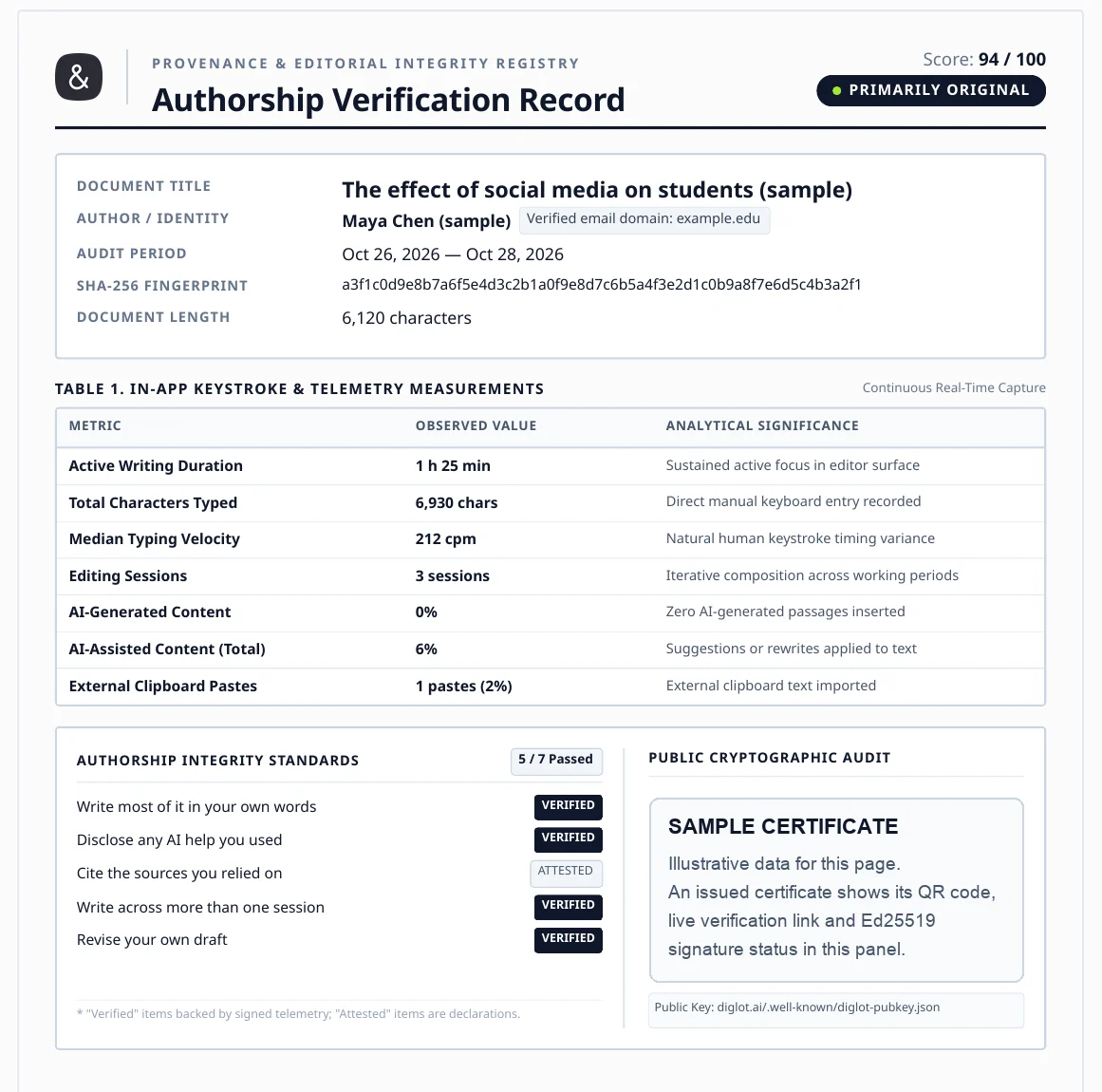
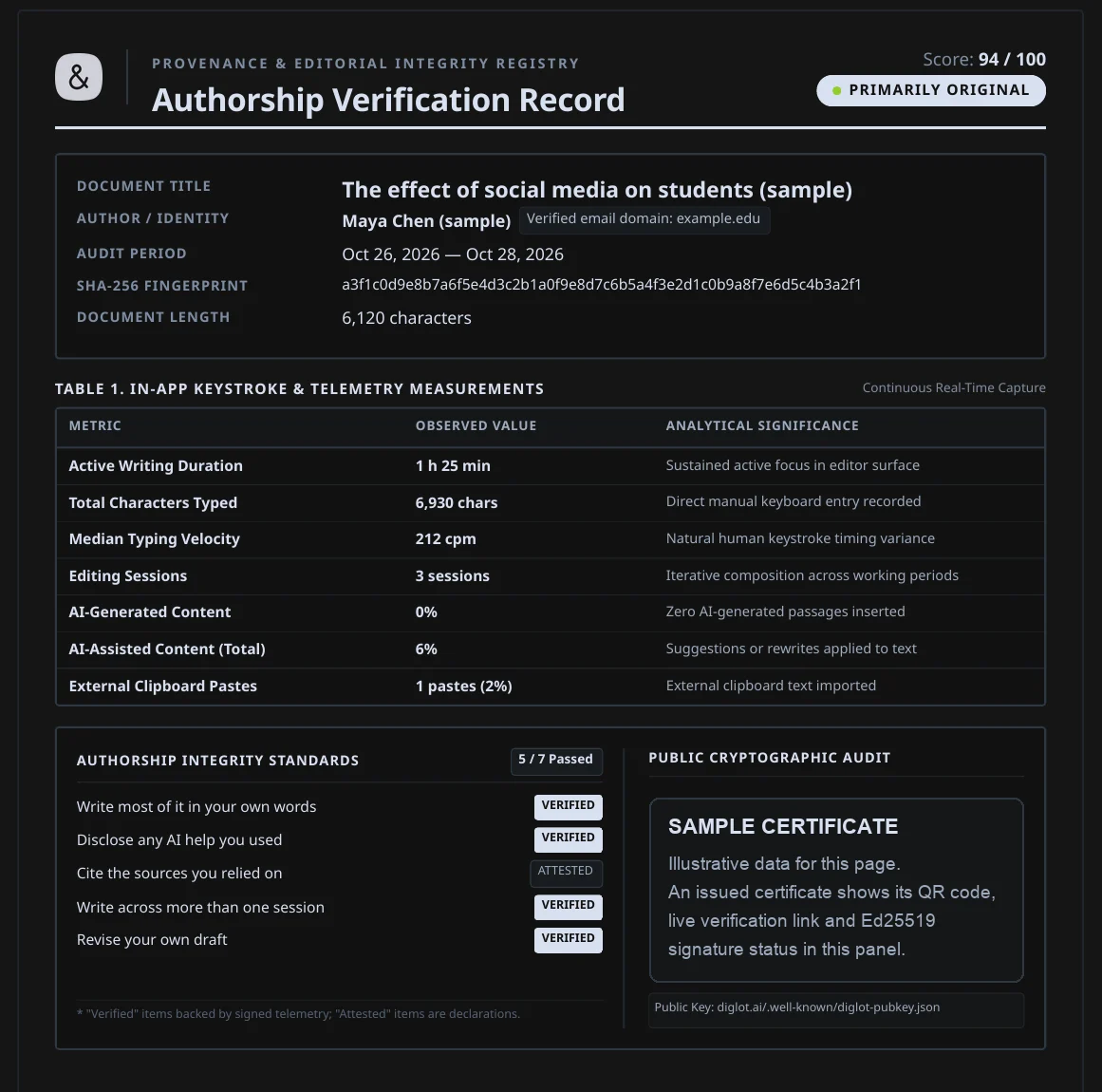
The Authorship Certificate records your writing process as an append-only, cryptographically signed log — proof that exists before anyone asks for it, rather than a defence assembled afterwards.
Version history
Every keystroke session, edit and revision recorded in order.
Signed log
Its signature makes changes after issue detectable.
Shareable
Hand the certificate link to your professor, committee, or publisher.
Free
Included in every Diglot plan — no add-on or upgrade required.
One window instead of five tabs and five bills
Before: five tabs
- Jenni AIAutocomplete and citations, but no help with a second language.~$20Unlimited, monthly
- DeepL ProTranslates outside your document, so citations and tone are lost.~$8.74from, monthly
- QuillBot PremiumRewrites one paragraph at a time in a separate tab.$19.95monthly
- Grammarly ProFixes the sentence without naming the first-language habit behind it.~$12per month, billed yearly
- ChatGPT PlusRewrites in its own voice and can invent references.$20monthly
If you pay for all five~$81/ month
After: one Diglot document
- Drafting, autocomplete and citations
- Translation inside the document
- Rewrites in five tones
- Grammar that names your first-language habits
- Cowriter with 30+ skills, every edit waiting for you
- Your PDFs, your glossary and a free Authorship Certificate
Publicly listed prices: Jenni AI verified 2026-07-18; DeepL, QuillBot and Grammarly verified 2026-04-13; ChatGPT Plus as listed by OpenAI. Prices change, so check each vendor before you buy.
Try a skill on a real paragraph
Your draft
Many researches shows that students which use social media more than three hours per day have lower grades. In our opinion this is because the constant notifications make difficult to concentrate, so the information is not stay in the memory.
We propose to migrate our reporting to the new platform in Q1. This will reduce costs a lot and the team will be more productive, because the old system is very slow and nobody likes it.
We are very sorry for the delay, it was not our fault but the supplier one. We will try to send you the goods until Friday, please be patient with us and don’t cancel the order.
Cowriter /formalize · Fluent AI
Many studies show that students who use social media for more than three hours per day have lower grades. We believe this is because constant notifications make it difficult to concentrate, so information does not stay in memory.
Example output written for this page to show the difference between AI tiers; real results depend on your text. Fluent AI is on Free, Native AI on Pro.
Every citation leads back to a real page and a real DOI
Your paragraph
The Transformer replaced recurrence with attention alone , and pre-trained encoders such as BERT carried the idea to language understanding . Attention mechanisms first improved neural machine translation .
References
- Vaswani, A., Shazeer, N., Parmar, N., Uszkoreit, J., Jones, L., Gomez, A. N., Kaiser, Ł., & Polosukhin, I. (2017). Attention is all you need. arXiv. https://doi.org/10.48550/arXiv.1706.03762
- Devlin, J., Chang, M.-W., Lee, K., & Toutanova, K. (2019). BERT: Pre-training of deep bidirectional transformers for language understanding. Proceedings of NAACL-HLT. https://doi.org/10.18653/v1/N19-1423
Your library · p. 1, abstract
We propose a new simple network architecture, the Transformer, based solely on attention mechanisms, dispensing with recurrence and convolutions entirely.
DOI resolves · 10.48550/arXiv.1706.03762
Example built from real papers and DOIs. In the editor, /library answers from the PDFs you upload, /check-sources looks each DOI up, and /find-source suggests papers for an uncited claim.
The slips your first language puts in your English
Thank you for your comprehensionThank you for your understanding
“Comprensión” is a false friend: in English it is “understanding”.
Actually, we use the old systemCurrently, we use the old system
“Actualmente” means “currently”, not “actually”.
I assisted to the conferenceI attended the conference
“Asistir a” means to attend; “assist” means to help.
temperature of samplethe temperature of the sample
Your language has no articles; English needs “the” here.
We discussed about the resultsWe discussed the results
“Обсуждать” takes a preposition; “discuss” does not.
It depends of many factorsIt depends on many factors
A calque of “зависит от”: English uses “depend on”.
Joined Sony 2020I joined Sony in 2020
Your language drops the subject; English needs it.
Yesterday I go to the clientYesterday I went to the client
The verb does not change for tense in Mandarin; English marks the past.
Sorry to bother you, if possible maybe could you send itCould you send it?
Layered politeness reads as unsure in English business writing.
He is having two carsHe has two cars
“Have” for ownership does not take the -ing form.
I am agree with the planI agree with the plan
“Agree” is already a verb; it needs no “am”.
Please do the needfulPlease take care of it
Common in Indian English, unclear to readers elsewhere.
I work here since three yearsI have worked here for three years
“Seit / depuis” becomes “for” with the present perfect.
We have discussed it yesterdayWe discussed it yesterday
A finished time like “yesterday” takes the past simple.
We will eventually postpone the launchWe may postpone the launch
“Eventuell / éventuellement” means “possibly”, not “in the end”.
Typical slips for each language group. Diglot flags them in your own draft and explains the habit behind each one.
Why one workspace beats a chatbot and four tabs
| What you need | Diglot | Jenni AI | Grammarly | QuillBot | ChatGPT |
|---|---|---|---|---|---|
| Draft in two languages in one documentQuillBot and ChatGPT translate in a separate tool or chat. | Yes | No | No | Partly | Partly |
| Explains the habit from your first languageChatGPT can explain if you ask, but not in your document. | Yes | No | No | No | Partly |
| Autocomplete and citation stylesDiglot: 10,852 CSL styles. Jenni AI: 10,000+ styles. | Yes | Yes | Partly | Partly | No |
| Answers from your own PDFs, with DOI checksJenni AI chats with PDFs. | Yes | Partly | No | No | Partly |
| 30+ slash skills inside the editorOthers offer a chat box or need written prompts. | Yes | Partly | No | No | Partly |
| Every change waits for your approvalRemoved text in red, new text in green, in place. | Yes | Partly | Partly | No | No |
| Free record of how the document was writtenGrammarly offers an authorship add-on. | Yes | No | Partly | No | No |
Based on public product pages; “Partly” means the job is possible but not inside your document, or only in part.
Turnitin and AI detection — questions
Does Turnitin detect AI?
It reports an estimate. Turnitin runs a separate AI-writing indicator alongside its similarity check, and returns a percentage of the document its model considers likely AI-generated. That number is a prediction about statistical patterns, not a detection of an act: it names no tool, no prompt, and no source. Turnitin itself instructs institutions to treat the score as a starting point for a conversation rather than as evidence.
Does Turnitin detect ChatGPT specifically?
No detector can identify which model produced a passage. Turnitin's indicator is trained to recognise text that looks statistically machine-like in general — not the signature of one product. Output from ChatGPT, Claude, Gemini or a human writing very evenly all land in the same bucket, which is precisely why the score cannot tell you who wrote something.
Is the AI score the same as the similarity score?
No, and confusing them causes a great deal of unnecessary panic. The similarity score measures overlap with existing sources and has existed for decades. The AI indicator is newer, separate, and measures something entirely different. A 20% similarity score and a 20% AI score mean nothing alike — see similarity score for the distinction.
How accurate is it for non-native English writers?
Worse than for anyone else, and this is documented. A Stanford study found AI detectors falsely flagged 61% of TOEFL essays written by non-native English speakers, while classifying essays by US-born students almost perfectly. The mechanism is not bias in the ordinary sense: detectors score statistical uniformity, and English learned through formal study is more uniform than English absorbed at home.
Should I check my essay with a detector before I submit?
You can, but hold the result loosely. Detectors disagree with each other, scores shift between drafts of the same document, and passing one tool tells you nothing about the one your institution runs. A score that reassures you today is not evidence you can show a committee tomorrow. Process evidence is.
What actually protects me if I am accused?
Evidence that the document grew over time: version history, earlier drafts with your own corrections, outlines, notes. Committees find a documented writing process far more persuasive than a counter-score from a different detector. If the stakes are high, the Authorship Certificate records that process cryptographically as you write.
Build proof before anyone asks for it
Diglot is a writing workspace for people who think in one language and publish in English — with a record of how the work was written.
Start for free*No credit card required
