Authorship Checklist
Do the work that makes it yours — and prove it.
AI detectors are often wrong about non-native English writers, and universities are switching them off. The checklist asks the real question: did you author it?
*No credit card required
- A per-document checklist of the human acts that make writing yours
- Auto-detects what it can from your real work — guides you to the rest
- Turns your process into a signed, shareable authorship record
The seven acts of authorship
Short answer Integrity guidance in the UK, EU, US, Canada and Australia names the same seven acts of authorship. Do them, and the work is yours.
- 1
Write your own thesis
The one thing no tool can do for you. Brainstorm with AI if you like — but the position the essay defends has to be yours.
- 2
Write most of it in your own words
Authorship lives in the typing. Translation and grammar help are fine; pasting AI paragraphs as your own is not.
- 3
Find and read real sources
Open the papers you cite. AI invents references — reading your sources is both good scholarship and your defence.
- 4
Cite every source you used
Attribute every borrowed idea, even one you paraphrased into your own words.
- 5
Make the analysis yours
Connect and evaluate sources — synthesis, not summary. This is the human work assessors look for.
- 6
Paraphrase in your own words
Rebuild the idea, do not relabel it. Synonym-swapping that keeps the source shape still counts as plagiarism.
- 7
Disclose the AI help you used
State which tools you used and how. The checklist pre-fills this from your actual use.
Live cockpit
The cockpit fills
as you write.
The checklist is not a separate chore. It is a live scoreboard — completing it just means genuinely writing your paper in Diglot.
Your writing activity
The checklist adapts to the document and records the work you do inside it.
Evidence it can verify
Sources, drafting and disclosed assistance are recognised from real work — no separate form to fill in.
What still needs your judgment
The few things only you can attest stay clearly separate, ready to attach to your certificate.
Two kinds of proof — and we never blur them
Short answer Some acts we can verify for you; some you simply declare. Keeping them apart is what makes the certificate honest — and stronger than a detector score.
Auto-verified — signed
How much you typed vs pasted, real sources cited, AI tools used. Backed by the same cryptographic signature as your Authorship Certificate — a third party checks it in the browser, no account needed.
Author-declared — labelled
"I verified each source exists." "The analysis is my own." Your statement, clearly marked as a declaration — exactly the AI-use declaration universities already ask for. Honest, never overclaimed.
Find real sources
Research the literature.
Keep every claim traceable.
The checklist asks you to read real sources. Diglot's research tools search 200M+ papers across nine databases so you can verify every claim.
Learn about Deep Research →Why a checklist beats a detector
Short answer Detectors guess about the finished text and are biased against ESL writers. A checklist documents the human work that produced it — process evidence, not probability scores.
Research · Stanford 2023
61.22% of ESL essays misclassified as AI by 7 commercial detectors
Published in Patterns (Cell Press); 89 of 91 fully human TOEFL essays were flagged by at least one detector. Native-speaker essays were flagged far less often.
Source: arxiv.org/abs/2304.02819
University policy · 2023–2026
Universities are switching detectors off
Waterloo discontinued its AI detector in 2025, citing "bias toward students whose first language is not English." Vanderbilt followed; MIT published guidance titled "AI Detectors Don't Work."
The shift · process evidence
From detection to authorship
Regulators and integrity scholars point to documented process — drafts, sources, disclosure — as the defensible proof of authorship. The checklist produces exactly that, on your terms.
Full background: The Authorship Checklist — What Actually Makes an Essay Yours
Free Authorship Certificate
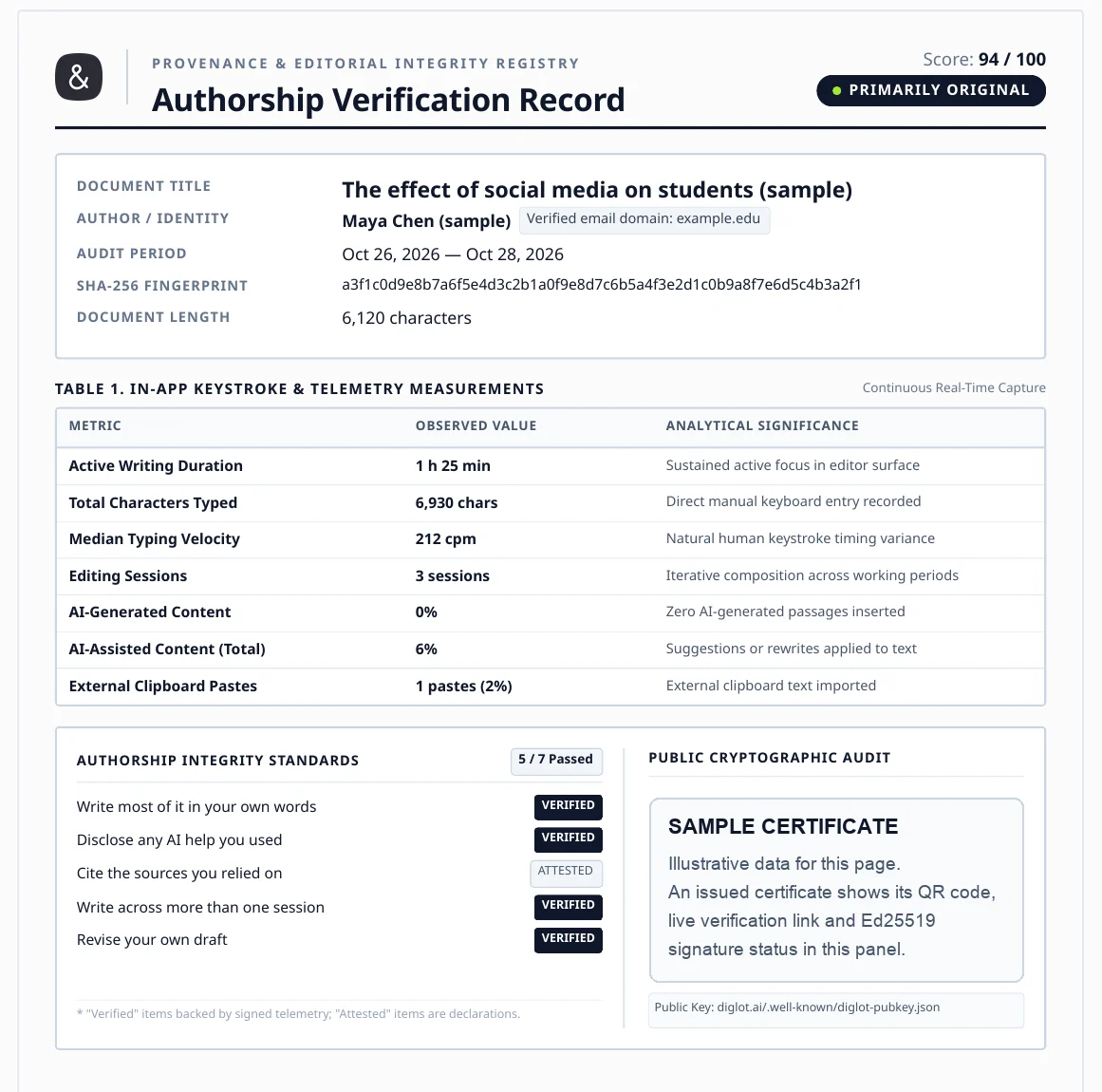
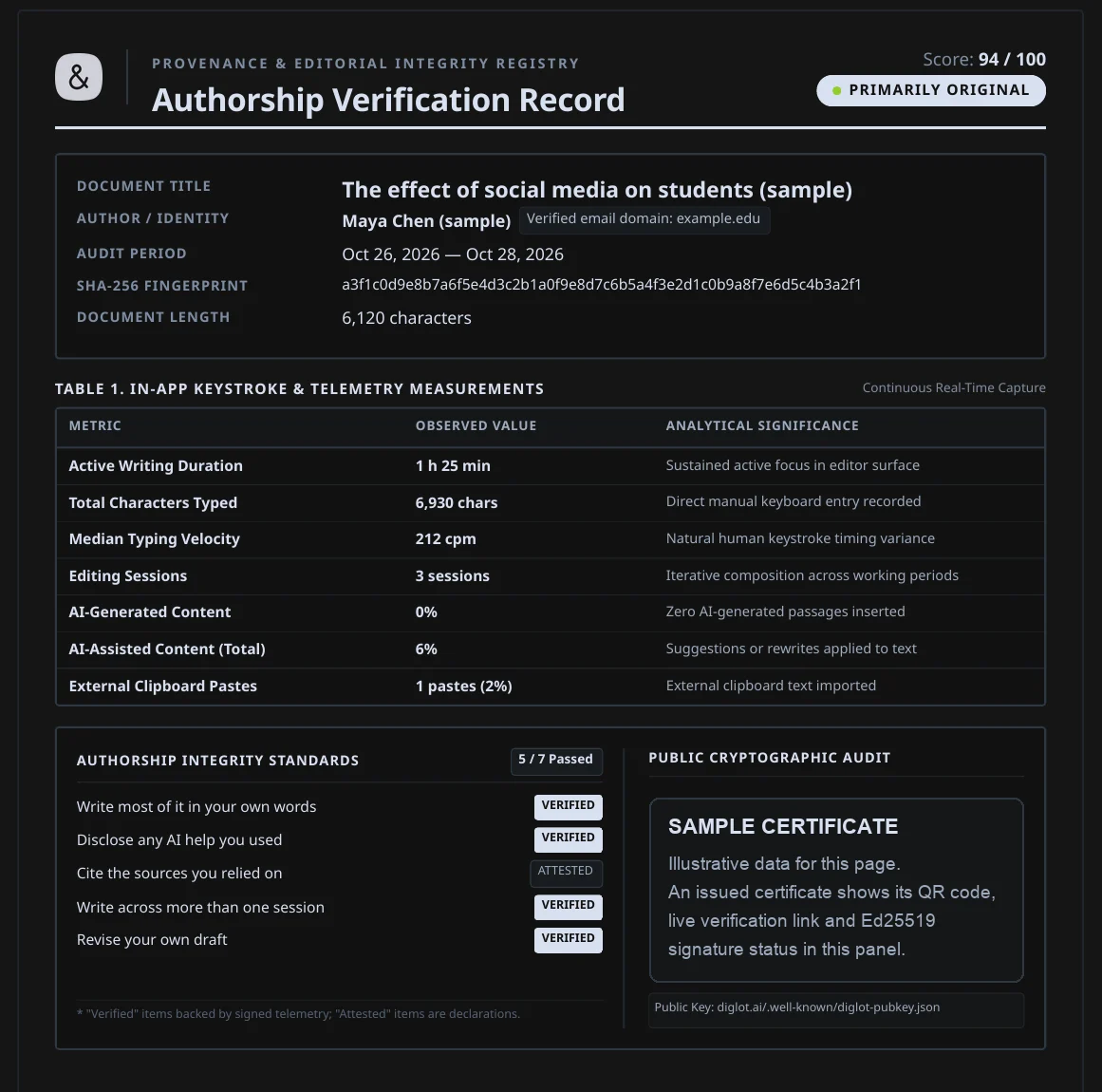
Your writing process becomes a signed record
Short answer Write in Diglot, then request a free, cryptographically signed Authorship Certificate. Anyone can verify it in the browser, no account needed.
Writing activity summary
A readable summary of the recorded drafting pattern, including typing, revision, paste, and AI-assistance signals.
Period & word count
When the writing started, when it ended, and how many words appeared in the final document.
Recorded surface
The certificate states where activity was captured. Today: the Diglot web editor.
Signature & public key
An ed25519 signature plus a pointer to the published public key. Verifiers check in the browser.
Authorship Checklist FAQ
What the checklist asks of you, what it leaves alone, and how it relates to the certificate.
Is using AI or translation to write an essay cheating?
Not by itself. Across UK, EU, US, Canadian and Australian guidance the line is drawn at authorship, not language mechanics. Translation, grammar help and disclosed paraphrasing are widely accepted; what must stay yours is the thesis, the choice and reading of sources, the analysis, and you must disclose AI use where required. Undisclosed wholesale generation — pasting an AI essay as your own — is the misconduct. The checklist is built around exactly this line.
Does completing the checklist guarantee a "Green" certificate?
No — and that is deliberate. The checklist is advisory. The signed Green/Yellow/Red verdict is a separate axis, based on how the text was built. We keep them separate on purpose: a partly self-declared checklist must never manufacture a cryptographic guarantee. The checklist guides you to defensible, well-authored work; the certificate independently records the process.
Why is this better than an AI detector?
Detectors guess about the final text, and they are wrong about non-native English writers more often than they are right — a Stanford study in Patterns (Cell Press) found commercial detectors flagged 61% of TOEFL essays as AI even when fully human-written. An authorship checklist does the opposite: it shows the human work that produced the document. Process evidence is what universities are moving toward as detectors are switched off.
Will it punish me for using translation or grammar tools?
Never. Using translation, fixing grammar or looking up a better word are language mechanics, not authorship — the University of Sydney explicitly says you do not even need to acknowledge spelling and grammar tools. The checklist treats these as help, the same way a dictionary is help. What it asks you to own is your thesis, your sources, your analysis, and your disclosure.
What data does the checklist use?
Only what your real work already produces inside Diglot — how much you typed, sources you cited, AI tools you used, sections you wrote. No new tracking and no biometric capture. Process evidence is opt-in and stays under your control; nothing runs as background surveillance.
When can I use it?
The Authorship Checklist is rolling out as part of the Diglot editor. The Authorship Certificate it attaches to is available today — start writing with a recorded, verifiable process now, and the cockpit lights up as it ships.
One window instead of five tabs and five bills
Before: five tabs
- Jenni AIAutocomplete and citations, but no help with a second language.~$20Unlimited, monthly
- DeepL ProTranslates outside your document, so citations and tone are lost.~$8.74from, monthly
- QuillBot PremiumRewrites one paragraph at a time in a separate tab.$19.95monthly
- Grammarly ProFixes the sentence without naming the first-language habit behind it.~$12per month, billed yearly
- ChatGPT PlusRewrites in its own voice and can invent references.$20monthly
If you pay for all five~$81/ month
After: one Diglot document
- Drafting, autocomplete and citations
- Translation inside the document
- Rewrites in five tones
- Grammar that names your first-language habits
- Cowriter with 30+ skills, every edit waiting for you
- Your PDFs, your glossary and a free Authorship Certificate
Publicly listed prices: Jenni AI verified 2026-07-18; DeepL, QuillBot and Grammarly verified 2026-04-13; ChatGPT Plus as listed by OpenAI. Prices change, so check each vendor before you buy.
Try a skill on a real paragraph
Your draft
Many researches shows that students which use social media more than three hours per day have lower grades. In our opinion this is because the constant notifications make difficult to concentrate, so the information is not stay in the memory.
We propose to migrate our reporting to the new platform in Q1. This will reduce costs a lot and the team will be more productive, because the old system is very slow and nobody likes it.
We are very sorry for the delay, it was not our fault but the supplier one. We will try to send you the goods until Friday, please be patient with us and don’t cancel the order.
Cowriter /formalize · Fluent AI
Many studies show that students who use social media for more than three hours per day have lower grades. We believe this is because constant notifications make it difficult to concentrate, so information does not stay in memory.
Example output written for this page to show the difference between AI tiers; real results depend on your text. Fluent AI is on Free, Native AI on Pro.
Every citation leads back to a real page and a real DOI
Your paragraph
The Transformer replaced recurrence with attention alone , and pre-trained encoders such as BERT carried the idea to language understanding . Attention mechanisms first improved neural machine translation .
References
- Vaswani, A., Shazeer, N., Parmar, N., Uszkoreit, J., Jones, L., Gomez, A. N., Kaiser, Ł., & Polosukhin, I. (2017). Attention is all you need. arXiv. https://doi.org/10.48550/arXiv.1706.03762
- Devlin, J., Chang, M.-W., Lee, K., & Toutanova, K. (2019). BERT: Pre-training of deep bidirectional transformers for language understanding. Proceedings of NAACL-HLT. https://doi.org/10.18653/v1/N19-1423
Your library · p. 1, abstract
We propose a new simple network architecture, the Transformer, based solely on attention mechanisms, dispensing with recurrence and convolutions entirely.
DOI resolves · 10.48550/arXiv.1706.03762
Example built from real papers and DOIs. In the editor, /library answers from the PDFs you upload, /check-sources looks each DOI up, and /find-source suggests papers for an uncited claim.
The slips your first language puts in your English
Thank you for your comprehensionThank you for your understanding
“Comprensión” is a false friend: in English it is “understanding”.
Actually, we use the old systemCurrently, we use the old system
“Actualmente” means “currently”, not “actually”.
I assisted to the conferenceI attended the conference
“Asistir a” means to attend; “assist” means to help.
temperature of samplethe temperature of the sample
Your language has no articles; English needs “the” here.
We discussed about the resultsWe discussed the results
“Обсуждать” takes a preposition; “discuss” does not.
It depends of many factorsIt depends on many factors
A calque of “зависит от”: English uses “depend on”.
Joined Sony 2020I joined Sony in 2020
Your language drops the subject; English needs it.
Yesterday I go to the clientYesterday I went to the client
The verb does not change for tense in Mandarin; English marks the past.
Sorry to bother you, if possible maybe could you send itCould you send it?
Layered politeness reads as unsure in English business writing.
He is having two carsHe has two cars
“Have” for ownership does not take the -ing form.
I am agree with the planI agree with the plan
“Agree” is already a verb; it needs no “am”.
Please do the needfulPlease take care of it
Common in Indian English, unclear to readers elsewhere.
I work here since three yearsI have worked here for three years
“Seit / depuis” becomes “for” with the present perfect.
We have discussed it yesterdayWe discussed it yesterday
A finished time like “yesterday” takes the past simple.
We will eventually postpone the launchWe may postpone the launch
“Eventuell / éventuellement” means “possibly”, not “in the end”.
Typical slips for each language group. Diglot flags them in your own draft and explains the habit behind each one.
Why one workspace beats a chatbot and four tabs
| What you need | Diglot | Jenni AI | Grammarly | QuillBot | ChatGPT |
|---|---|---|---|---|---|
| Draft in two languages in one documentQuillBot and ChatGPT translate in a separate tool or chat. | Yes | No | No | Partly | Partly |
| Explains the habit from your first languageChatGPT can explain if you ask, but not in your document. | Yes | No | No | No | Partly |
| Autocomplete and citation stylesDiglot: 10,852 CSL styles. Jenni AI: 10,000+ styles. | Yes | Yes | Partly | Partly | No |
| Answers from your own PDFs, with DOI checksJenni AI chats with PDFs. | Yes | Partly | No | No | Partly |
| 30+ slash skills inside the editorOthers offer a chat box or need written prompts. | Yes | Partly | No | No | Partly |
| Every change waits for your approvalRemoved text in red, new text in green, in place. | Yes | Partly | Partly | No | No |
| Free record of how the document was writtenGrammarly offers an authorship add-on. | Yes | No | Partly | No | No |
Based on public product pages; “Partly” means the job is possible but not inside your document, or only in part.
Write so you can always prove it
Start with a recorded, verifiable process today. Pair it with the Authorship Certificate for a signed, shareable record of your work.
*No credit card required
